A world is more than a mesh.
How generated geometry became an articulated, coherent, playable machine army.
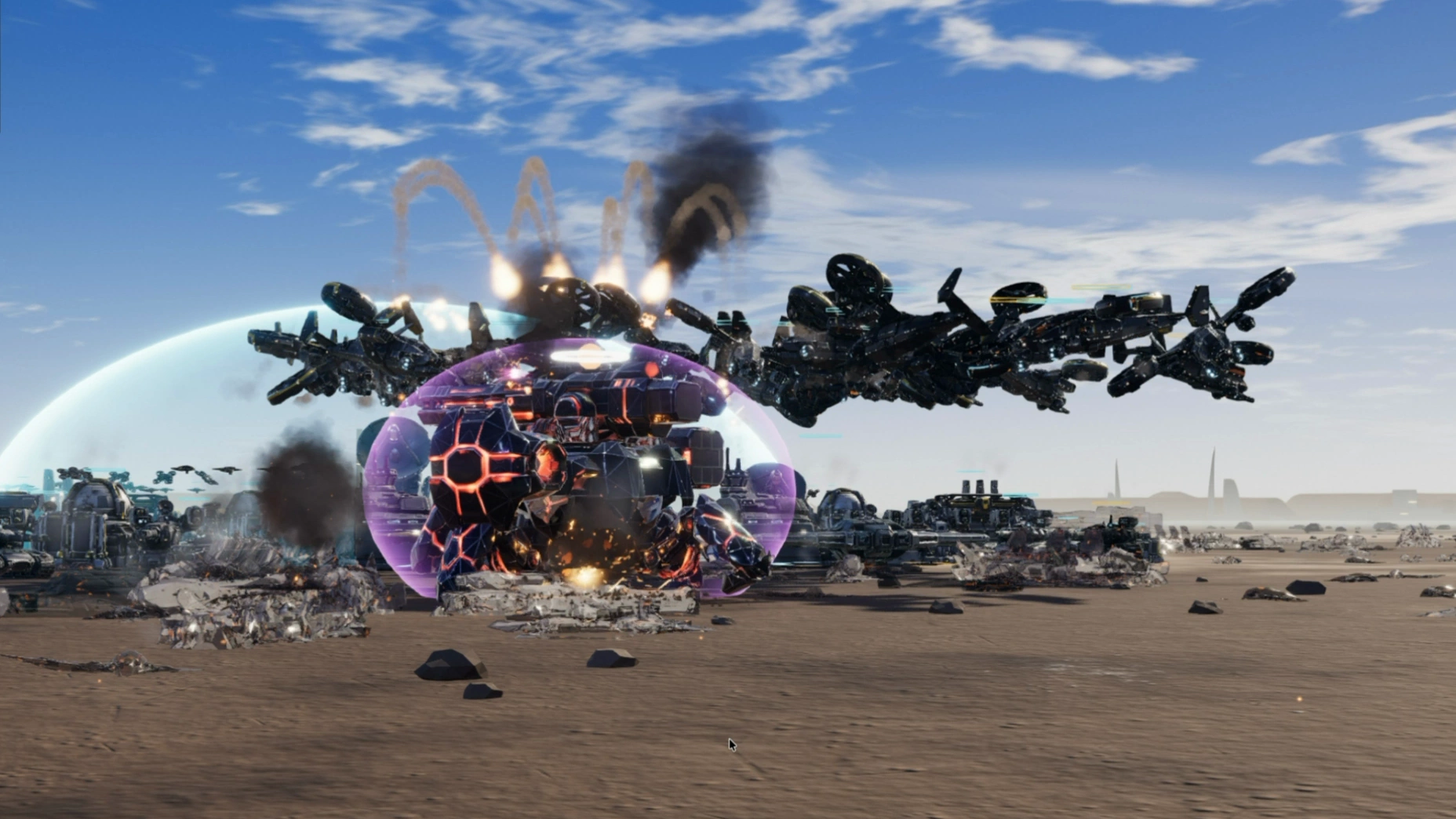
Appearance is only the beginning
The first Rampart Zero battlefield used procedural geometry. It was enough to prove the simulation, but a convincing mechanical world demanded more: weight, readable silhouettes, moving components, and a visual language shared across the roster.
The asset pipeline began with image-to-3D experiments in April, gained variant review in May, and evolved into a programmable forge. By the end of October, the game’s pipeline documentation recorded 44 units, structures, and enemies rebuilt from Tripo-based meshes.
An image cannot define the rules
A generated model can suggest the appearance of armor or the shape of a weapon. It must not decide health, damage, cost, collision, or navigation. Those values belong to stable gameplay data.
That separation lets a visual asset improve without quietly changing how the battle works. The tank can gain a new silhouette while retaining the same simulation contract. A beautiful mesh that breaks targeting or blocks a route incorrectly is not ready for the game.
Mechanical objects have to move
A turret needs a real rotation pivot. A barrel needs a credible muzzle. A walker needs leg segments that remain attached and articulate at every level of detail. Aircraft need the correct orientation, scale, and weapon origins.
The forge uses automated Blender processing to segment, normalize, simplify, prepare components, and export runtime assets. Articulation and attachment data continue through the rendering pipeline so a weapon effect comes from the weapon rather than an arbitrary point in space.
Review is a production stage
Generating another candidate is easy. Maintaining a consistent world is harder. The project introduced explicit variant comparison and selection rather than treating the newest output as automatically better.
Materials, faction identity, silhouettes, level-of-detail budgets, texture treatment, and in-game lighting all need review together. A standalone model preview can hide failures that become obvious at tactical distance or under the battlefield’s actual renderer.
The final image belongs to the game
The website now uses gameplay footage and captures from the current game renderer instead of reconstructing its assets in an unrelated lighting setup. The distinction matters: the materials, articulation, effects, and environment are part of the art.
The lesson reaches beyond this project. Generative tools become a production capability when they sit inside a reproducible system of selection, transformation, validation, and play. The result is a coherent world whose machines can move, fight, and survive the demands of play.
Based on the development retrospective through November 1, 2026. Historical test figures describe their recorded workloads; they are not new compatibility or performance guarantees. Rampart Zero remains in development.
Explore the gameSpeed needs direction.
What a fast prototype can teach you—and what only months of iteration can reveal.
A voice of your own.
An intelligent command interface belongs beside the player, with a clear job and clear limits.
Give the player a way back.
Why repair, salvage, and field autonomy matter as much as the next explosion.