Give the player a way back.
Why repair, salvage, and field autonomy matter as much as the next explosion.
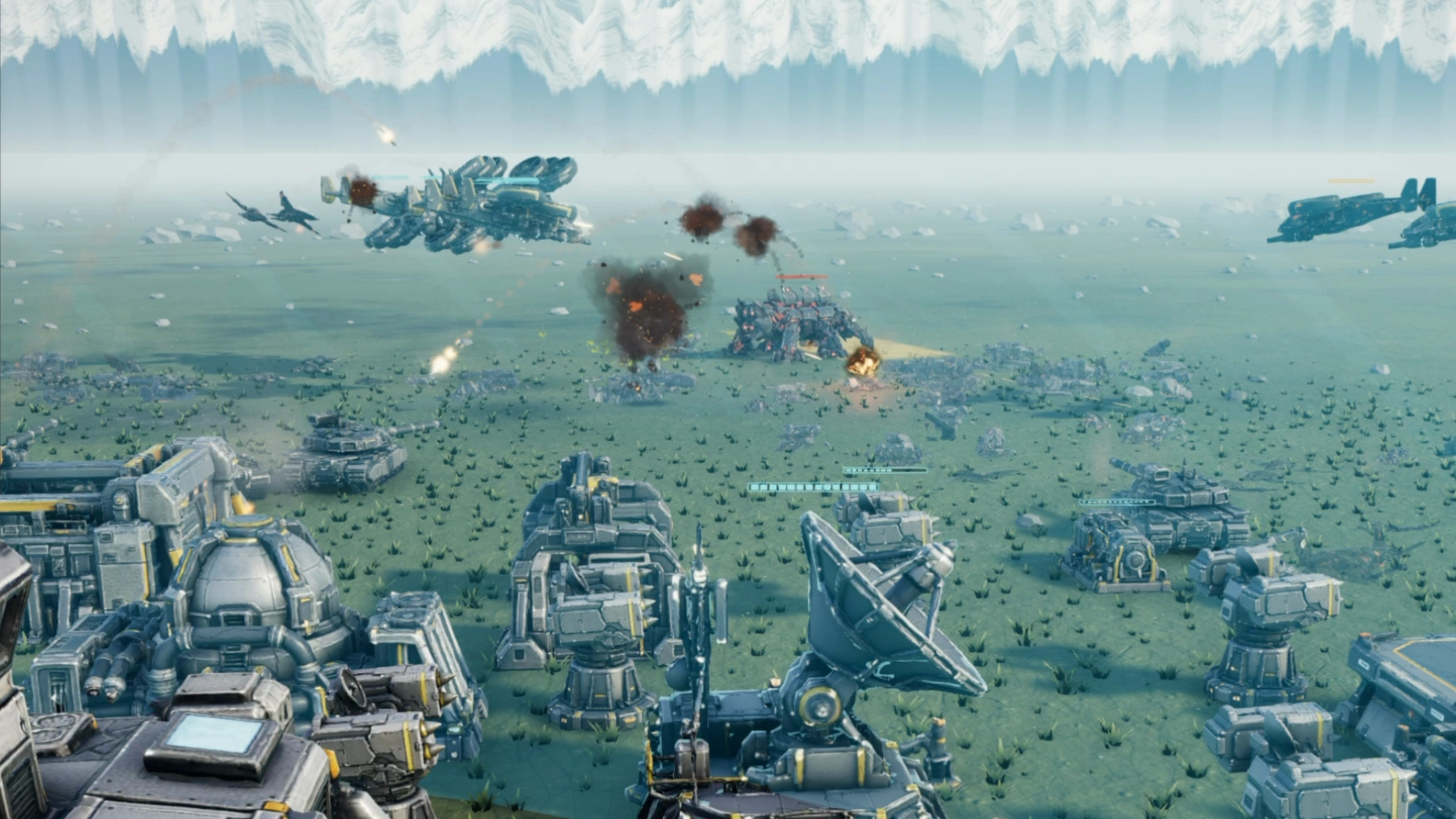
A loss should create a decision
Fortress defense is built around pressure. But pressure becomes more interesting when the player can do more than replace whatever was destroyed. October’s design work made recovery a central part of Rampart Zero.
Repair Bays, Engineers, salvage, research, and servicing connect the aftermath of one wave to preparation for the next. Spend on a replacement force, recover an existing vehicle, or invest in a capability that will change the next fight: each choice draws on the same limited resources.
Autonomy supports intention
An Engineer can recover salvage and repair vehicles. Damaged forces can withdraw to powered service infrastructure and later return to their assignments. Movement and queue handling matter because a theoretically useful service system fails if its vehicles block one another.
These behaviors reduce repetitive supervision while preserving player authority. A direct order takes priority. The purpose is to make the army competent enough to carry out your strategy, not to make the strategy for you.
The support network is part of the battle
Aircraft have finite sortie ammunition and return to Airfields for rearming. Shields draw power. Research competes with present-day military needs. Losing infrastructure therefore changes what the army can sustain.
This creates decisions across different timescales: respond to a threat now, preserve a wounded unit, keep the power network working, and build toward the next capability. A strong base is a set of relationships rather than a collection of expensive objects.
Beyond the feature checklist
The implemented campaign spans fifteen waves and a Titan encounter, with endless play available afterward. That structure gives progression a destination, but it does not settle balance or onboarding.
The development history is candid about what remains: full-run testing, readable threats, a comprehensible first session, and evidence that players want to return. These questions guide the private playtest. Finishing a system is the beginning of learning whether it serves the game.
Based on the development retrospective through November 1, 2026. Historical test figures describe their recorded workloads; they are not new compatibility or performance guarantees. Rampart Zero remains in development.
Explore the gameSpeed needs direction.
What a fast prototype can teach you—and what only months of iteration can reveal.
A voice of your own.
An intelligent command interface belongs beside the player, with a clear job and clear limits.
A world is more than a mesh.
How generated geometry became an articulated, coherent, playable machine army.