MotionBricks
Range.
The next step, generated.
The whole experiment, inside a browser.
A third-person shooting range built to explore a different way of animating a character: generate the motion as it is needed, on the player’s own machine.
A glimpse of
what comes next.
Actual live gameplay.
1080P / 00:55 / SILENT RECORDING
What the film shows
An armed operator moves through a grey-box shooting range, aims and fires at physical targets, and switches weapons. Colored skeletons expose the generated movement ahead of the character. The camera follows through movement and aiming; the on-screen diagnostic panel shows the active motion runtime. This is a silent gameplay capture, with no spoken narration.
What if movement
could be made on demand?
Four recent poses. A desired future. A neural model that fills the distance between them.
MotionBricks Range takes NVIDIA’s pretrained motion system out of its native research runtime and into a TypeScript game. WebGPU handles local inference; a playable world tests what the output can actually do.
This is a separate experiment from Rampart Zero. The shared interest is how intelligent systems can make an experience more expressive while leaving the player and the simulation in control.
Generate ahead.
Stay grounded.
- 01 / INTENTION
Choose a future.
Camera-relative input and reference poses describe where—and how—the character should move.
- 02 / GENERATION
Make the transition.
MotionBricks generates a short sequence locally. Playback continues while the next sequence is prepared.
- 03 / PHYSICS
Respect the world.
Rapier resolves the capsule’s movement. Collisions constrain the trajectory the model proposed.
- 04 / CONTINUITY
Begin from reality.
The displayed, physically corrected motion becomes context for the next generation.
DISPLAYED MOTION → NEXT CONTEXT → NEW GENERATION
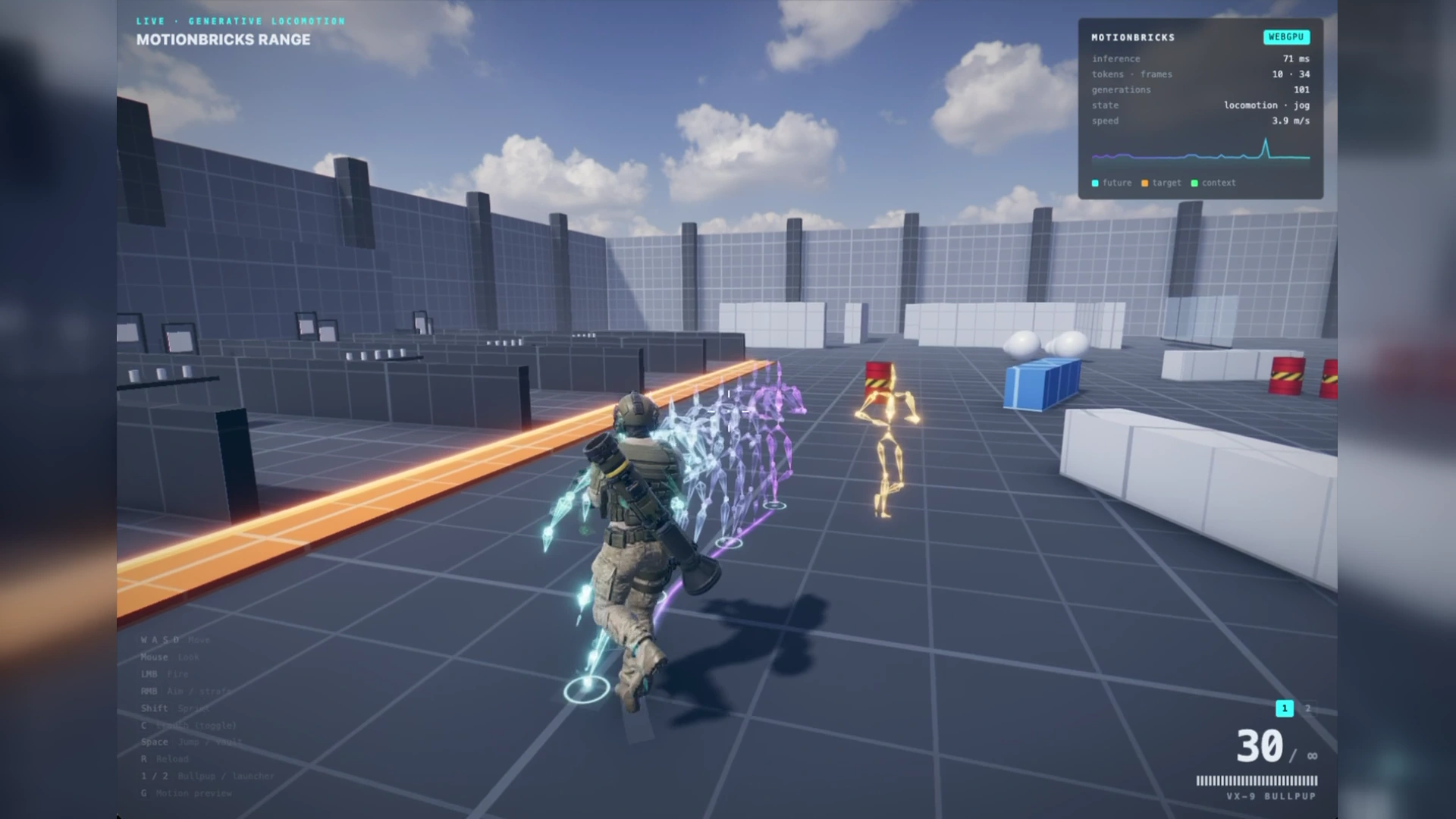
The prediction
becomes visible.
A diagnostic view makes the model’s work legible: what it has been given, what it predicts, and where those predictions meet the world.
- Cyan → violet
- Generated future poses, ordered from near to far.
- Amber
- The target poses the model is steering toward.
- Green
- Recent movement supplied as context.
- Footfall rings
- Predicted contacts along the future trajectory.
Historical measurements on the tested desktop, not new benchmarks or device guarantees. Generation produces a segment of motion; it is not run once per rendered frame. The gameplay film is encoded at 30 frames per second. The recorded iPad Air attempt failed during initialization.
Read the engineering storyOpen the work.
Follow the decisions.
The repository includes the TypeScript runtime, retargeting, physics integration, generated-asset workflow, and model, gait, and responsiveness tests. Its historical repository name is 3rd-person-physics-sandbox.
Application code: MIT. NVIDIA’s model weights and sample clips have separate terms; the clips are supplied for evaluation. See the repository’s licensing and asset attribution before reuse. This feature presents gameplay footage and stills, not a hosted model download.
A recent desktop Chromium browser with WebGPU is the preferred reproduction target. Setup downloads the separately licensed model and reference clips; a WASM fallback exists, but broad device support has not been established. Follow the repository’s current README for setup.